How to measure · P0
Standing / orthostatic blood pressure check
VitalGauge includes seated and “upon standing” BP fields so you can notice large drops that matter if you feel lightheaded. Clinical definitions are stricter than a casual stand-up reading.
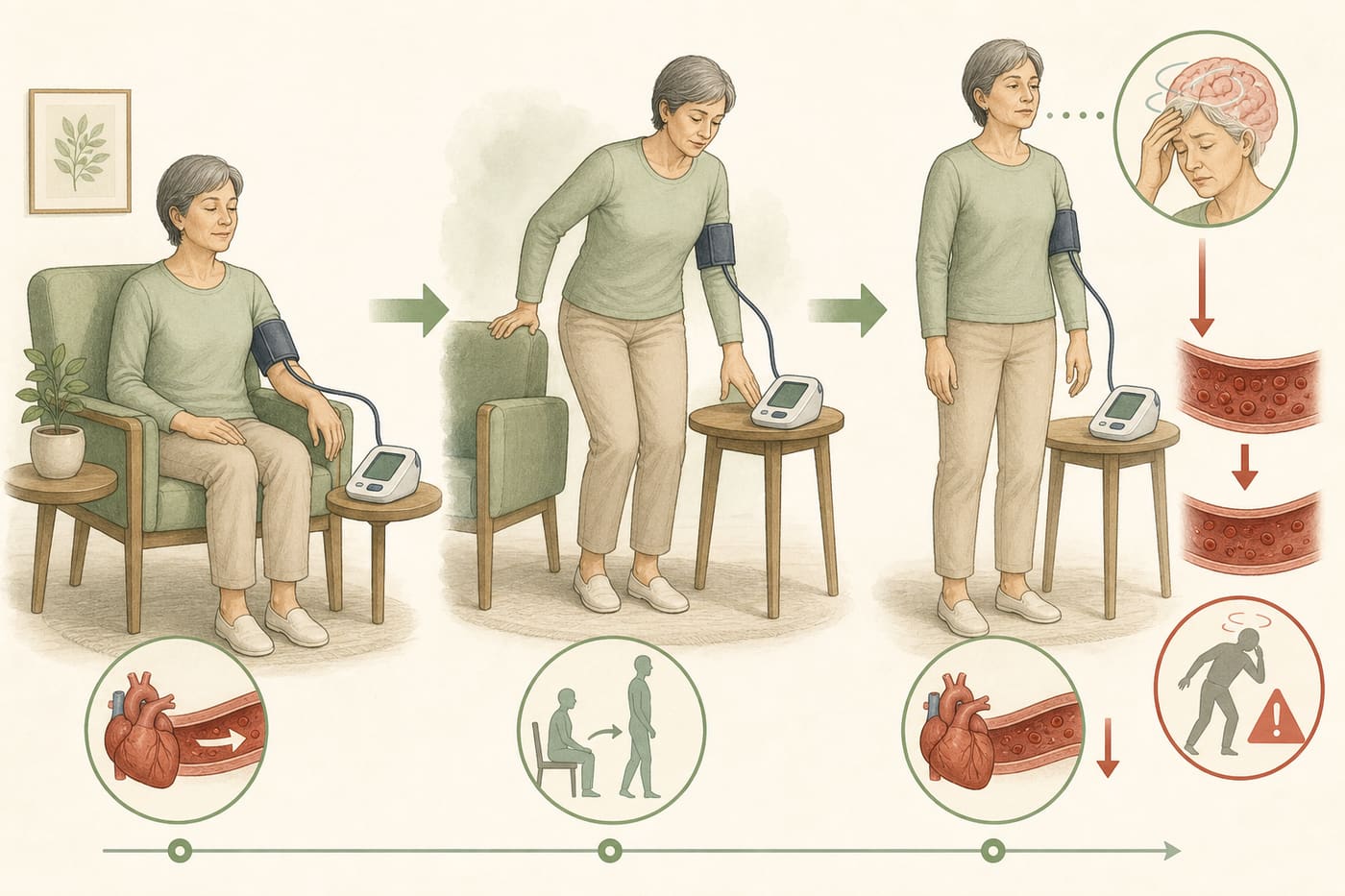
What clinicians mean by orthostatic hypotension
A common clinical definition is a sustained drop of ≥20 mm Hg systolic or ≥10 mm Hg diastolic within about 3 minutes of standing (often after a supine rest).12 Sit-to-stand maneuvers produce smaller drops than supine-to-stand, so thresholds and sensitivity differ; research has explored alternate cutoffs for sit-to-stand protocols.3
VitalGauge’s “upon standing” fields are a DIY logging aid inspired by that clinical idea — not a full orthostatic workup.
Safe DIY sequence for the app
| Order | Action | Log in VitalGauge |
|---|---|---|
| 1 | Rest seated (or supine if your clinician taught that) ~5 minutes; take a proper arm-cuff reading. | BP systolic/diastolic (seated) |
| 2 | Stand carefully; keep a chair or counter nearby. Do not lock knees aggressively. | — |
| 3 | After ~1 minute standing (and again near 3 minutes if you can), repeat the cuff reading with arm supported. | BP systolic/diastolic (upon standing) |
| Stop | If dizzy, sit/lie down immediately. Seek urgent care for syncope, chest pain, or severe symptoms. | Do not force a reading |
Issues illustrated
| Issue | Problem | Better practice |
|---|---|---|
| Standing too fast | False “drop” from technique + real dizziness risk. | Rise slowly; support nearby. |
| Comparing different arms / cuff positions | Noise looks like orthostasis. | Same arm, same cuff height relative to heart. |
| Treating sit-to-stand as gold-standard OH diagnosis | Sit-to-stand is less sensitive than supine-to-stand at classic cutoffs.3 | Bring logs to a clinician; ask which protocol they want. |
| Ignoring symptoms | Numbers without dizziness history miss urgency. | Symptoms + drop → clinical conversation same day if severe. |
Alternative educator themes (not medical advice)
| Educator | Theme | VitalGauge framing | Citation |
|---|---|---|---|
| Dr. Eric Berg | Electrolyte balance (K/Mg) when discussing BP physiology | Hydration/electrolyte food themes — not DIY IV or mega-dose self-treatment for dizziness. | Berg Na/K ratio4 |
| Dr. Sten Ekberg | Metabolic fitness context; avoid aggressive training while symptomatic | Easy walking after meals; pause hard intervals if dizzy on standing. | Ekberg5 |
| Dr. Josh Axe | Food-first minerals, sleep, and stress for circulatory comfort | Habits only; fainting needs clinical evaluation. | Axe BP lifestyle6 |
| Dr. David Jockers | Stress load and mineral-rich meals | Downshift + food density; not a stand-up “test and treat” protocol. | Jockers7 |
| Dr. Hulda Clark | Clean-living DIY observation | Log symptoms/environment — reject cure/cleanse claims for syncope. | NCCIH cleanses8 |
In the app
A sizable seated→standing systolic drop on home checks can trigger an educational watch-out. That is a prompt to talk with a clinician — not an orthostatic hypotension diagnosis.
Home BP technique · Open the app
Citations
- Joseph A, et al. Orthostatic Hypotension. StatPearls / NCBI Bookshelf. NBK448192
- Kaufmann H, et al. overview in Merck Manual Professional — orthostatic hypotension definition and exam timing. Merck Manual
- Shaw BH, et al. Optimal diagnostic thresholds for orthostatic hypotension with a sit-to-stand test. PMC5542884
- Berg, E. (educational). Sodium–potassium ratio themes. drberg.com
- Ekberg, S. (educational). drstenekberg.com
- Axe, J. (educational). draxe.com
- Jockers, D. (educational). drjockers.com
- NCCIH. Detoxes and Cleanses. nccih.nih.gov